

The single-signal sequence
What happened
29% of invites accepted, and 10% of messages answered1
Buyers can spot a sequence in the first line. And push the volume, and LinkedIn restricts the account.
Most teams either spam LinkedIn… or go on mute.
Neither works. Drumbeat works out what’s actually worth doing, for each person, every day.

Here’s what people tried. And here’s what happened.
What happened
29% of invites accepted, and 10% of messages answered1
Buyers can spot a sequence in the first line. And push the volume, and LinkedIn restricts the account.
What happened
1 in 10 messages answered, however many you send1
The same averages, just bigger numbers. And the more you send, the sooner LinkedIn restricts you.
What happened
86% of B2B professionals don’t post regularly2
Your buyers are reading. Your team isn’t there.
What happened
Marked as AI slop.
People spot it in a line, and scroll on. It reads like everyone else’s, because it is.
Take a team of ten, and 20,000 people in their market. Each person could invite, message, comment on or reply to any one of them today. That’s 800,000 things your team could do. They have time for about a hundred.
And that’s the simple version. Add every topic worth posting about, every moment to post it and every way to say it, and the options run towards infinity. Picking the right hundred by feel, every day, for every person, isn’t something anyone can do.
Mathematicians call this constrained optimisation: far more choices than capacity, and one best answer somewhere in between. So that’s how we treat LinkedIn. Drumbeat works out what every possible action is worth, and hands each person the few that matter most, as the day unfolds.
Signal-based tools run on a simple idea: someone changes jobs or likes a post, so you act. It’s a good start. But a signal on its own doesn’t tell you much.
What gives it meaning is context. Who you are, and who they are. Whether they fit your ICP, and whether they sit on a buying committee. How many people at their company your team already knows. What’s happening in their market this week.
Signals and context combine in ways that aren’t obvious: two weak signals in the right context can matter more than one strong one out of it. Drumbeat’s models weigh all of it together, for every person, every day.
These are a sample, not the full set. With all that context, for each person, every day, they predict:
Language models are brilliant with language, so that’s what we use them for: reading what people write, and helping each person say what they mean, in their own voice.
But who’ll accept an invite, which post will travel and what a reply is worth are questions of probability, and a language model is a poor judge of probability. So Drumbeat pairs them with statistical models that predict outcomes, ranking models that weigh every option against every other, and business rules that keep everything safe and on brief. Each does the job it’s best at. Then a person makes the call.
Read the context, and write in each person’s own voice.
Predict what’s likely to happen: who accepts, who replies, what travels.
Weigh every option against every other, for the next ten minutes.
Pacing, eligibility, and whatever your team has ruled out.
Make the final call.
Each candidate action gets an estimate of what it is likely to be worth: classifiers score the parts that can be scored (will this person accept, will this post travel, will this message get a reply), and those estimates carry their uncertainty with them rather than hiding it behind a single number.
A ranking layer then orders the candidates against each other, because the question is never “is this a good action?” but “is this the best use of the next ten minutes?”. Rules and constraints sit on top: pacing inside what LinkedIn tolerates, eligibility, who has already been contacted, what the team has decided is off limits.
Models are chosen and kept on outcomes. If a method stops predicting well for your business, it stops being used for your business.
“Everyone else is trying to automate LinkedIn. We automate the decision, then help you take that action as well as it can be taken. Think Iron Man, not the Terminator.”
 Parry Malm CEO, Drumbeat
 Nobody wants a bot posting for them, and buyers can smell one. The answer isn’t less AI. It’s AI that starts from a real idea, and sounds like you.
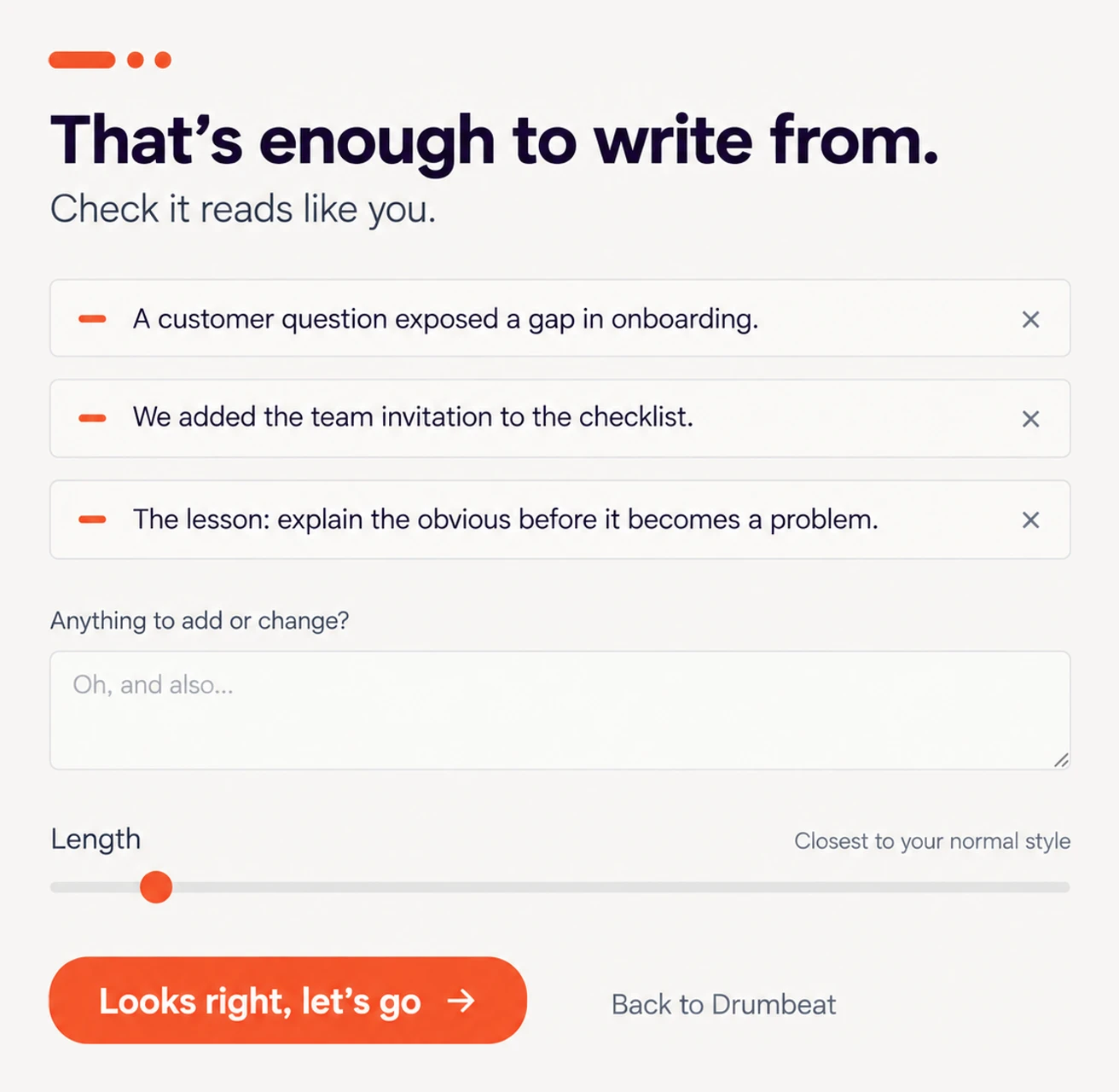
Slop is a bad idea, written well. Riff draws out what only you know, from your own work or what’s happening in your market, before a word is drafted. Once the idea is right, the writing is the easy part.
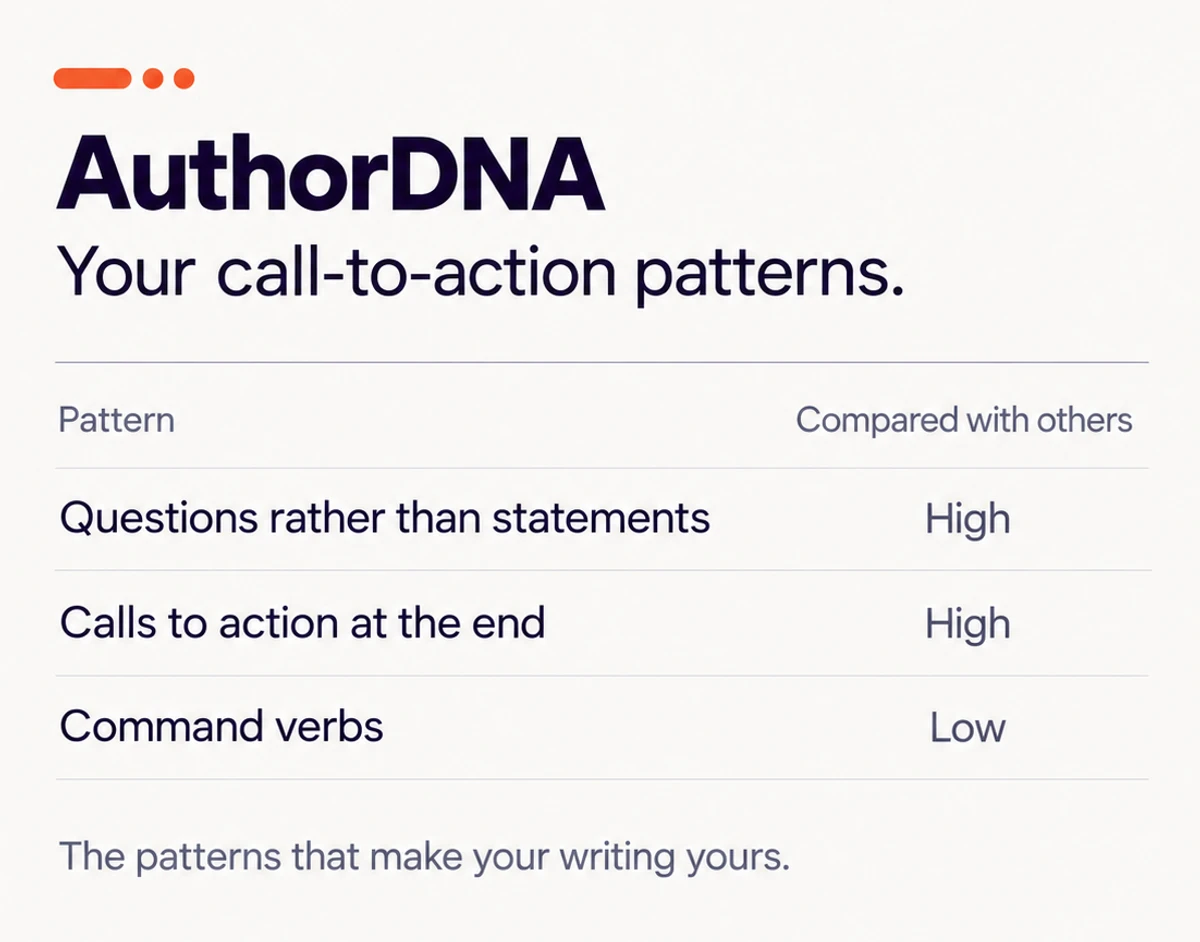
AuthorDNA learns how you write from what you’ve already written, across 243 measures: rhythm, vocabulary, how you open, how you sign off. Every draft is scored against them before you see it.
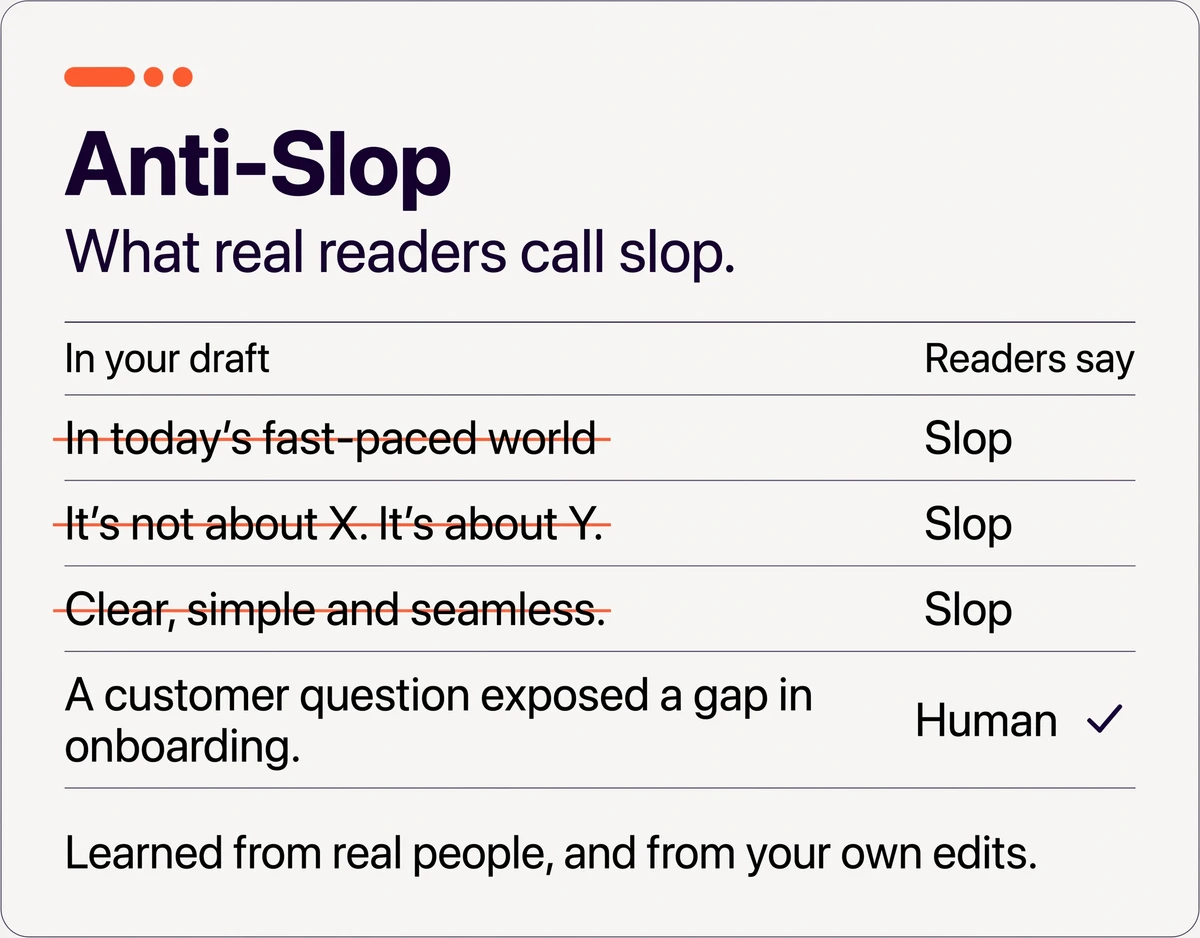
Anti-Slop isn’t an AI marking its own homework. It learns what real readers actually call slop, strips those tells before you see the draft, and keeps adapting to your preferences, and everyone else’s.
No one lives in a vacuum. Everything you do affects someone else, and what they do affects you. Drumbeat understands this, learns from it, and optimises your next best actions as a result.
Drumbeat starts with your company, ICP, market and available signals. Then it adds your team’s own decisions and outcomes.
6× more posts per week
Especially the subject-matter experts you wish would post more. From one post every six weeks to nearly one a week (0.16 → 0.99).
+50% more likely to accept your invite
When a prospect has engaged with a colleague’s post: 58% acceptance against 39% cold. Deeper into your industry, prospects and customers.
6 days to a rep’s first conversation
Median, from their first invite. 83% of reps have their first conversation inside 30 days.
10.6 conversations a month for daily users
Daily users average 10.6 conversations a month. What each one is worth is your number, not ours.
Drumbeat works out what’s worth doing, for each person, every day.